Find out where you stand in the AI search layer. Free audit.
Get Started →AI Visibility Specialists
Your patients are not just Googling you any more.
They are talking with an AI model.
And the model answers with whoever published first, most consistently, and with the most citable authority.
In most cities, that is not you yet. It could be.
Nobody told you
where to start.
That is not your failure. Medical school taught you medicine. It did not teach you marketing, and it was never supposed to. By the ten-year mark in private practice, most US physicians have tried some version of this:
- Asked the office manager to handle social. She already had a full-time job.
- Hired a cousin's friend who does marketing. Two posts, then silence.
- Bought a course on Instagram growth. Watched the first module. Never finished.
- Signed with a generalist agency at $3,000 to $8,000 a month. The decks got prettier. The schedule did not.
- Tried posting yourself. Ran out of time in week two.
- Ran Google Ads with no one watching the account. Spent five figures on clicks that never converted.
- Hired a healthcare specialist who could not define HIPAA out loud.
- Ran a Meta ad that violated a health-claims rule. Lost the ad account for thirty days.
None of that makes you bad at marketing. It makes you a physician doing a second job under-equipped. The people selling you the first version of that job were selling templates.
Here is what
that has cost.
AI Search Volume · H1 2025
Share of global search volume now going through AI platforms
Up from 3–7% a year earlier
Your patients are not searching you on Google any more. They are asking a model.
And the model is quoting whoever published first.
Source: BrightEdge, 2025
The reason it kept failing
is not you. It is the category.
Healthcare marketing was built, priced, and staffed by people who had never earned a clinical reputation. That shows up seven ways on a physician's feed.
The old question was:
where do we rank?
The new question is:
what does ChatGPT say when a patient asks?
In the last twelve months, the search layer of the internet quietly split in two.
- Google, Bing, ten blue links, a map pack
- What every agency still optimises for
- A list of physicians. The patient decides.
- Gradually losing share to AI month by month
- ChatGPT, Perplexity, Gemini, Claude, Google AI Overviews
- Almost no healthcare agency has named this out loud yet
- The model does not show a list. It answers with one name
- That answer is produced by what you and your competitors have published
The model returns a name.
Sometimes yours.
Usually not.
The physician whose name is returned becomes the default specialist in that market for that question. Without a single ad spend.
Your own content has to be citable.
Clinical specificity. Named frameworks. Consistent voice. Proper schema. Structured answers to the questions your patients are actually asking. Generic "5 tips" carousels are invisible to models because they are redundant to the model's training data.
Your external citations have to match.
Reviews, media mentions, directory listings, podcast appearances, local press, speaking engagements. Trust Architecture is the layer AI uses to decide which physician is the authority. If your citations are thin or inconsistent, the model defers to someone else.
Your voice has to be uncopyable.
The only voice that survives the AI era is the one that is unmistakably a specific human. This is where brand work becomes the moat AI cannot cross. Be encountered, not consumed. Build a world, not just a product.
Some doctors become
THE NAME.
Most do not.
The physicians everyone asks about, "how are they everywhere?", did not hire a better vendor. They built a brand.
A brand that sounds like them.
A brand that teaches before it sells.
A brand that makes a first-time patient say, "I feel like I already know you."
The difference is not the agency.
physician branding · ai era
A brand the models can find, and the competitors cannot fake.
That is not content marketing. That is physician branding.
It is what we do.
It is the only thing we do.
We are a creative agency that chose medicine on purpose.
Not healthcare-marketing-as-a-category. That category is the problem. We build brands for physicians, around physicians, with physicians, across California, Texas, and a handful of international markets where our clients have practices, partners, or ambitions.
We believe doctors who have spent a decade earning their expertise deserve marketing that sounds at least as careful. And infrastructure sophisticated enough to be found in the search layer that is about to replace Google.

Seven steps.
No templates.
No slop.
Your Voice. Extracted, Not Imitated.
We sit with you for a morning. We record how you explain a diagnosis to a nervous patient, how you reassure a family, how you walk a colleague through a differential. That recording is the source code for everything we write. The brief is never "write a post about knee pain." It is "write the way Dr So-and-so explained it on the call at 11:42."
Education First. Always.
The 80/20 rule is the number every healthcare agency gets wrong. Eighty percent of your content teaches. Twenty percent promotes. Flip those ratios and your feed reads like a pharma ad, which is the register patients have been trained to distrust. Byron Sharp has been writing about mental availability for fifteen years. Physician content is how doctors get it.
Five Minutes of You. A Month of Content.
Video is the highest-trust format in healthcare and the lowest-friction format for the physician. We film you for five minutes. We ship Reels, carousels, audiograms, pull quotes, and a long-form article. One sitting. A full month of feed. No production crew. No script. No make-up chair.
Trust Architecture. Built for the AI Citation Layer.
This is the part most agencies do not know is a job yet. Reviews, schema, digital PR, structured Q&A, directory hygiene, podcast placements, proper E-E-A-T signalling for healthcare authors. The quiet infrastructure AI models use to decide which physician in which city to cite. We run the audit. We fix the gaps. We stand up the scaffolding that makes you retrievable when a patient asks ChatGPT, Perplexity, or Google AI Overviews "who should I see for [condition] in [city]."
Compliance Is a Design Constraint, Not an Afterthought.
Every piece goes through a compliance workflow before it reaches your account. We know which claims the FTC restricts. We know the difference between a testimonial, a review, and a public-health statement. You should not have to pay a lawyer to vet an Instagram caption. You should not have to hope your agency did not do something stupid.
We Report on Booked Consultations, Not Reach.
Reach is a leading indicator of activity, not of business. Every month you receive the one number that matters: how many new-patient inquiries came from content. If a pillar is not producing, we kill the pillar. Not the report.
We Stay on the Account.
The person who pitched you is the person running your account in month eighteen. We do not solve retention by rotating juniors through your brand. We solve it by only taking clients we intend to serve for years.
The AI slop problem
is now a medical problem.
Patients are deciding whether to trust you based on content they can see was not written by you. And increasingly, based on answers generated by models that have to choose between what you publish and what your competitor publishes.
What Slop Looks Like on a Doctor's Feed
A Wikipedia summary with your logo on it. A "Did you know" carousel that would work for a cardiologist, a chiropractor, or a chiropodist. A caption with the clinical warmth of a user manual. Stock photos of produce and running shoes under the words "your health matters." None of it is specific to you. All of it is being indexed, including by the models that will be asked about you tomorrow.
Why It Is Dangerous
It erodes trust. A patient who senses a machine wrote the post assumes a machine runs the practice.
It flattens distinction. When every agency runs the same prompt on the same model, every feed converges. Byron Sharp calls this the distinctiveness tax. In healthcare, the tax is paid in missed bookings.
It misroutes intent. AI content attracts the low-intent scroller. It does not convert the patient who has been researching symptoms for three weeks.
It makes you invisible to the AI layer. A model can only cite what is specific enough to cite. A "5 tips" carousel is semantically identical to ten thousand others.
The Swap Test
Take any post from your feed. Replace your name with a competitor's. Does it still make sense? If yes, the post is not about you. Delete it. Authentic content is unswappable because it carries your clinical voice.
The Midnight Test
A patient is awake at 2am researching symptoms. Does your post make them stop and think, "this doctor actually understands what I'm going through"? If not, it is not building trust. It is taking up space.
The Colleague Test
Would you be proud to show this post to a colleague at a medical conference? The content is your clinical reputation. Most agencies have never been asked that question.
The Citation Test
If a patient asked ChatGPT for your specialty in your city and the model returned a summary of this post, would it name you? Or would it read as generic and cite someone else? That is the test that matters most in 2026.
Slop vs.
Physician-Authentic
Honest About
Who We Work With
✓ This is for you if...
- You own or co-own a private practice in California or Texas
- You have been disappointed by at least one agency
- You want to be the name of your specialty in your city
- You are willing to be on camera for five minutes a week
- You care what a sceptical colleague thinks of your feed
- You want patients, not followers
- You want to be the name ChatGPT returns when a patient in your city asks
✕ This is NOT for you if...
- You want to outsource marketing and never think about it
- You are shopping on price
- You want virality disconnected from your clinical work
- You expect a hundred new patients next month from Instagram
- You are employed by a hospital system and do not own your brand
- You are unwilling to be the face of your practice
Specialties We Build Brands For
Each with a first-mover opportunity in the AI search layer, and a specific reason most agencies are getting it wrong.
Three Phases.
One Retrievable Brand.
- Deep-dive: your voice, your patients, your competitors, your market
- Content strategy built around your clinical expertise
- Social audit vs. your top three local competitors
- Citation audit: what ChatGPT, Perplexity, Gemini, and Google AI Overviews currently say about you
- HIPAA-compliant workflows installed
- Platform selection based on where your patients actually are
- Physician-led video coaching: we teach the five-minute format until it is muscle memory
- Production of Reels, carousels, articles, and shorts, all in your voice
- Educational pillars go live across platforms
- Trust Architecture built into the asset layer: schema, structured Q&A, digital PR targets, review-velocity plan
- Local SEO aligns to the content strategy
- Patient journey mapped: first impression to booked consultation
- Thought-leadership placement: podcasts, local press, speaking
- Paid amplification of the organic work that already performs
- Monthly reporting on booked consultations and AI citation share
- How often you are the name the models return in your category and market
- Quarterly in-person strategy session in LA or Texas
The cadence is boring on purpose. Boring compounds. Viral does not.
Results Speak for Themselves.
Find Out Where You Stand
in the AI Search Layer
We will audit your social media, check your AI citation share, compare you against your top three local competitors, and give you specific recommendations, whether you work with us or not.
What You'll Receive:
- A citation audit: what ChatGPT, Perplexity, and Google AI Overviews currently say about you
- A side-by-side social presence comparison vs. your competitors
- Your biggest content gap identified
- Three content ideas tailored to your specialty and market
- An honest assessment of your current agency's work
- A HIPAA compliance check on your existing social content
A real person from our team will review your practice and respond within 48 hours.
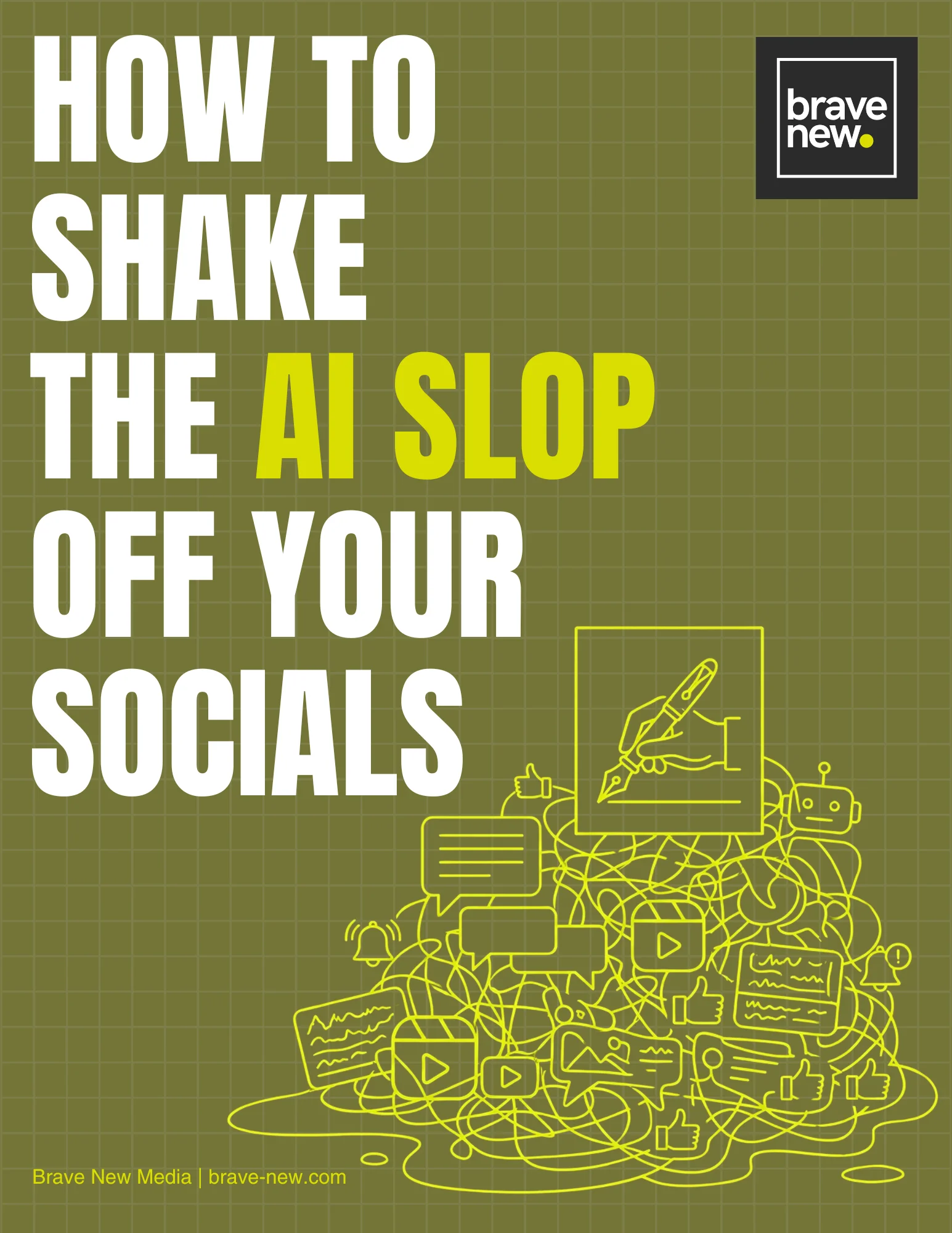
How to Shake the AI Slop
Off Your Socials
- The AI Slop Test — Five tells your content was written by a machine, and what your patients have already noticed
- The Voice Extraction Framework — How to turn a five-minute phone recording into a month of authentic content
- The 80/20 Healthcare Content Rule — Why education converts and promotion does not
- The HIPAA Content Checklist — What you can post, what you cannot, and why, in plain English
- The Five-Minute Video Formula — One recording. Ten deliverables. Zero production crew.
- The Trust Timeline — Why healthcare content takes 90 days to convert, and why your last agency left at day sixty
- The AI Citation Playbook — How to become the physician ChatGPT, Perplexity, and Google AI Overviews return when a patient in your city asks for your specialty. GEO, AEO, and LLM-SEO in eight steps.
- The Platform Priority Matrix — Which platform matters most for your specialty. It is rarely Instagram.
If it did not start, click here to get it.
You spent a decade becoming an expert.
You should not spend another one waiting to be recognised as one.
Your patients deserve to find the real you. Not a template. Not a stock photo with your name on it. Not a feed a model wrote on behalf of an agency that has never met a patient. Not a generic answer from another model the next time a patient asks who to trust.
Let us build something that sounds like you, teaches like you, earns the citation on your behalf, and converts like only you can.
'How to Shake the AI Slop Off Your Socials'